
Sudden Food Rejection in Kids: Why Accepted Foods Disappear and What to Do 🤷♀️
QUICK ANSWER
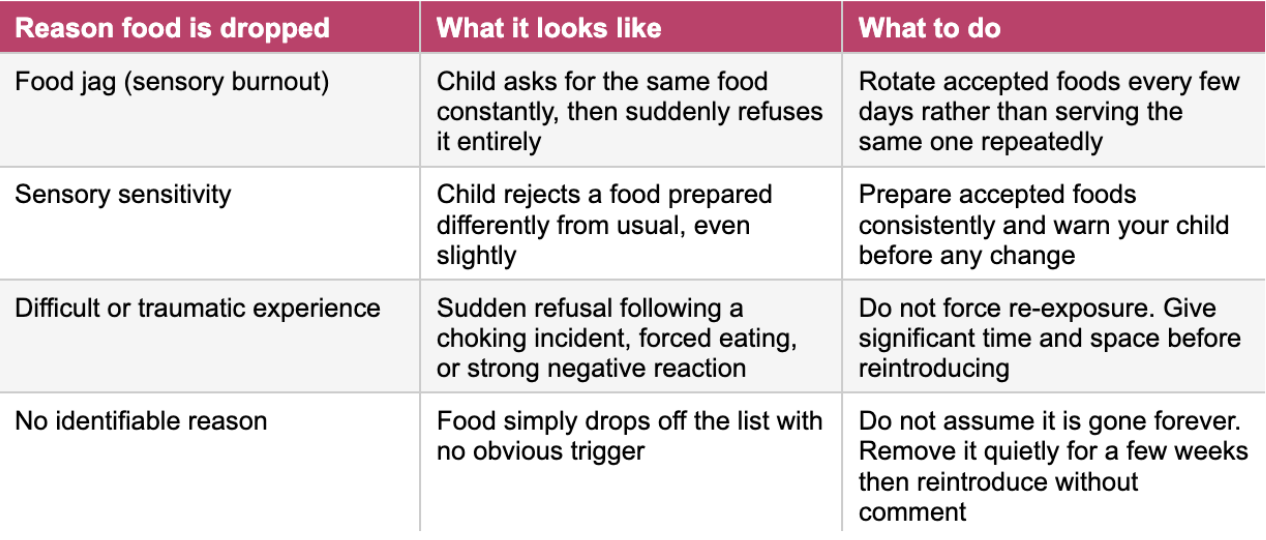
When a child suddenly refuses a food they used to eat, it is usually caused by one of four things: food jags (sensory burnout from eating the same food too often), sensory sensitivity (the food being prepared differently), a difficult experience, or no identifiable reason at all. The response in all cases is the same: remove the food quietly, give it time, and reintroduce it without any pressure or comment.
For children with a limited diet, the few foods they do accept can feel like a lifeline to worried parents. When those previously accepted foods begin to be refused, it can feel genuinely frightening. In this article we cover what causes sudden food rejection in kids, how to reduce the chance of it happening, and how to respond when you see it beginning.
A note on terminology: We use the term accepted food rather than safe food throughout this article. The word "safe" can imply that foods a child does not eat are somehow dangerous, which is not a helpful framing for a child who is already anxious around food. Accepted food is a more neutral term. If "safe food" is language that feels right to you, know that we use both terms as synonyms and mean exactly the same thing.
What Is an Accepted Food and Why Do Picky Eaters Depend on Them So Much?🧐
An accepted food is any food a child accepts around half the time it is served. It does not have to be a favourite, and it does not need to be eaten 100% of the time.
This is completely understandable. But it also means that when an accepted food starts to be refused, the anxiety can spike sharply. Understanding why this happens is the first step to responding calmly. The Ellyn Satter Institute's Division of Responsibility in Feeding is one of the most useful frameworks for understanding the parent's role and the child's role around food, and it helps take some of the weight off accepted foods as the measure of whether things are going well.
Why Do Kids Suddenly Refuse Foods They Used to Eat? The 4 Main Causes
Sudden food rejection in kids usually has one of four causes. Understanding which is driving the refusal helps you respond in the right way.
What is a food jag and how does it cause sudden food rejection?
A food jag is the clinical term for what happens when a child asks for the same food repeatedly, becomes over-exposed to it, and then burns out on it entirely. Think of a child who wants blueberries at every meal for three weeks, and then one day refuses them completely and never asks for them again.
How does sensory sensitivity cause a child to suddenly reject an accepted food?
For children with heightened sensory sensitivity around food, very small changes in how a food is prepared can make it feel like an entirely different food. A pasta shape that is slightly different from usual. A yoghurt that has a different consistency than expected. A sandwich cut into rectangles instead of triangles.
This level of sensitivity is often, though not exclusively, associated with selective eating patternsthat go beyond typical picky eating, and sometimes with neurodivergence including autism. But it can also appear in children who simply have a particularly finely tuned sensory system. HealthyChildren.org (AAP) has useful guidance on the difference between typical picky eating and eating patterns that may benefit from professional support.
Can a bad experience cause a child to permanently reject a previously accepted food?🍎
Yes. A choking incident, a forced feeding experience, a strong unexpected flavour, or any moment that creates a powerful negative association with a food can remove it from a child's accepted list, sometimes permanently.
What if my child refuses a food for no obvious reason?
Sometimes there is no identifiable cause at all. Children sometimes simply decide they no longer want food, with no apparent trigger and no logical explanation.
How Do You Prevent Sudden Food Rejection and Minimise the Risk of Accepted Foods Being Dropped?🥪
The most effective way to prevent sudden food rejection in kids is to vary what you serve so that no single accepted food appears more than every few days, unless it is nutritionally essential.
This is one of the practical benefits of following a responsive feeding approach, where you are in charge of what is served and when. When the parent controls the menu, it is far easier to rotate foods and prevent the overexposure that leads to food jags. The Ellyn Satter Institute calls this the parent's side of the Division of Responsibility: you decide what, when, and where. Your child decides whether and how much.
Is Your Anxiety About a Lost Food Actually About Your Child, or About You?🤷♀️
This is the most important question in this article, and it is worth sitting with honestly. When a food feels critical, ask yourself: is it critical for your child's health, or is it critical for your peace of mind?
Note: We do not recommend hiding vegetables as a feeding strategy. It can undermine trust when children discover the change, and it does not address the underlying relationship with food.
How Can You Serve Accepted Foods in New Ways Without Risking Rejection?
The golden rule is to always warn your child before a change. Never serve an accepted food in a different way without telling them first.
Sudden Food Rejection in Kids: The 4 Causes at a Glance
Ready for Personalised Support?
If you are worried about your child's accepted foods disappearing or their diet becoming more limited, the Easy Bites App is built to help. Request your personalised Picky Eater Report to understand what is driving your child's eating and get practical, evidence-based guidance tailored to their specific needs. You do not have to figure this out alone.
Next Steps for Your Journey: Losing a favorite food is frustrating, but it’s often a sign your child is ready for a new approach. If you’re worried about their long-term nutrition, read our guide on Balanced Nutrition Without Pressure or download the Easy Bites app for personalized mealtime support.
Frequently Asked Questions❓
What is a food jag? 🧀
A food jag is when a child demands the same food at every meal for an extended period, then suddenly refuses it entirely. The clinical explanation is sensory burnout: the child's system has been overexposed to the same sensory experience and has switched off from it. Food jags are one of the most common causes of sudden food rejection in picky eaters. The best prevention is rotating accepted foods so the same food does not appear more than every few days.
Will a dropped food ever come back? 🫐
Often, yes. Many foods that appear to be dropped permanently can be recovered with patient, pressure-free reintroduction after a period of absence. Remove the food quietly for two to three weeks, then bring it back alongside familiar safe foods without drawing any attention to it. Offer it many times before concluding it is truly gone. Parents who serve it calmly and consistently, with zero expectation, often find the food re-accepted over time.
How many accepted foods should a picky eater have? 🥣
Child feeding specialists often use 20 accepted foods as a rough clinical indicator. Children eating fewer than 20 foods may benefit from professional support. That said, every child is different, and the quality and variety within those foods matters as much as the number. HealthyChildren.org has guidance on when picky eating warrants a conversation with your paediatrician.
My child used to eat everything and now only accepts a handful of foods. What happened? 🍎
This is one of the most common and confusing experiences in early childhood eating. Food neophobia, the biological wariness of new foods, peaks in toddlerhood and often causes children who ate a wide range of foods as babies to become much more selective between ages 2 and 5. This is a normal developmental phase and is not caused by anything you have done wrong. The phase typically improves by school age, especially when mealtimes remain calm and pressure-free.
Should I hide vegetables to make sure my child gets enough nutrition? 🥦
No. Hiding vegetables is not a strategy recommended by child feeding experts. When children discover they have been given food without their knowledge, it can seriously undermine trust around mealtimes and cause previously accepted foods to be dropped. It also does not address the underlying relationship with food. Focus instead on repeatedly exposing your child to vegetables at the table, without any pressure to eat them, alongside foods they already accept.
Until next time,
Easy Bites
