
How to Shift Your Mindset Around Feeding Your Child (and Why It Changes Everything)
Quick Answer
You have probably been told to "just trust your child" around food, and wondered what that actually means in practice. The answer is responsive feeding: a gold-standard approach where you decide what is served and when, and your child decides whether and how much to eat. Three steps make this shift possible, and most parents find their mealtimes calmer within weeks.
Change is hard. Whether you are trying to build a new personal habit or trying a new way of parenting, doing things the same way we have always done them is our default. Truth be told, it is way easier not to change.
However, the very fact that you are here reading this suggests that you may be ready, or at least open, to doing things differently in relation to feeding your child. Maybe things are not going brilliantly with food, or perhaps you just want to learn about best practice or increase your confidence.
Here is the hard truth: much of what we do as parents when it comes to feeding is 100% socially normal, but not especially helpful. Often, we parent the way we were parented. Or we can get so caught up with trying to get kids to eat healthily that we slip into counterproductive approaches at mealtimes.
Learning how to shift your mindset around feeding your child is one of the most powerful things you can do at mealtimes. Moving to responsive feeding, considered the gold standard by paediatric nutrition experts, takes effort and intentionality
What Is Responsive Feeding and Why Is It the Gold Standard?
Responsive feeding is the approach where you are in charge of what appears on the table, and your child is in charge of what goes in their mouth. That one shift changes everything.
Responsive feeding centres on a clear division: you decide what is offered and when, and your child decides whether to eat and how much. This approach, endorsed by paediatric nutrition experts and the American Academy of Pediatrics, is considered the gold standard because it supports both healthy growth and a positive lifelong relationship with food.
So what does this actually look like at the dinner table? 🥗
Trusting your child to decide how much they want to eat from the foods you provide, or even whether they want to eat them at all. 👶
Taking charge of meal planning, so you decide which foods are served 🍒
Setting up a meal and snack routine in your home that is flexible and appropriate 🥦
No more encouraging, persuading or pressuring them to eat or try foods ❌
No more restricting them or telling them they have had enough of a certain food 🧑🧒🧒
Making mealtimes about connection, not correction. The focus is on time with your child, not getting food down them 🥰
Eating with them so you are available to connect, can be a role model, and build their familiarity with a wide range of foods 🥑
Serving family style to support a positive relationship with food. Read more in our family style meals article.🍚
The clinical framework behind all of this is called the Division of Responsibility in Feeding, developed by dietitian Ellyn Satter. The idea is simple: you are responsible for the what, when and where of eating. Your child is responsible for whether they eat and how much. When both sides hold up their end, mealtimes stop being a battle.
Moving from “it is my job to get these healthy foods down my kid” to “I can trust them to make their own eating decisions” is a major mindset shift. Here is how to get there.
How Do You Actually Make the Mindset Shift? 3 Steps That Work
Step 1: Build your motivation by understanding why responsive feeding works
If you can really engage with the why of responsive feeding, you will feel far more motivated to change.
It is never enough just to tell a person to do it like this. In our experience, as parents learn more about the psychology of feeding kids, the ideas they are absorbing begin to resonate. The way you parent has to feel good to you, and you have to understand why you are doing it. You can take a deeper dive by reading our other blog posts or checking out the resources inside the Easy Bites App. The goal is to reach a place where you genuinely believe that pressure-free mealtimes are better for your child's long-term relationship with food. Because they are. And the research backs this up.
Step 2: Name the beliefs that are stopping you from trusting your child
This is the most important step. Most of the barriers to responsive feeding are beliefs we have never actually examined.
Take some time to honestly ask yourself, or talk it through with your child's other parent if that applies: what is actually stopping me from trusting my child around food? Be as specific as you can. Some of the most common ones we hear are:
“I know better than they do what counts as a healthy diet.”
“If I do not direct their eating, they will not meet their nutritional needs.”
“If I do not restrict them sometimes, they will grow up to have a problem with their weight.”
“If I do not encourage eating, they will not grow properly.”
Any of those land? You are not alone. These beliefs feel completely logical, and many of them came from how we were raised. But most of them fall apart when you actually test them, which is what Step 3 is for.
Step 3: Test your fears, and watch most of them dissolve
Most of these beliefs can be tested or set aside, and most parents are surprised by the results.
Some beliefs can be tested directly. For example, if you feel your child does not weigh enough, you can get their weight and growth checked by a health professional. If they are thriving, that fear can be set aside.
The belief that comes up most is: "if I stop encouraging them, they will eat nothing." This is the one most parents worry about when they first think about how to stop pressuring their child to eat. And it is almost never what actually happens.
Other beliefs can be evaluated with a wait-and-see approach. You may feel your child will not eat well if they are not firmly guided. Give responsive feeding a genuine try for a couple of months, and you may be amazed at how much more relaxed and confident they are at mealtimes. By supporting their autonomy with food, you are indirectly empowering them to feel far more confident with new foods in the long term.
Note: we are not recommending a free-for-all. Read the linked articles carefully to get a solid understanding of responsive feeding before you start.
Is This the Right Approach for Us? A Quick Reference Guide
Yes, if you want mealtimes to feel calmer and your child to build a healthy relationship with food for life.
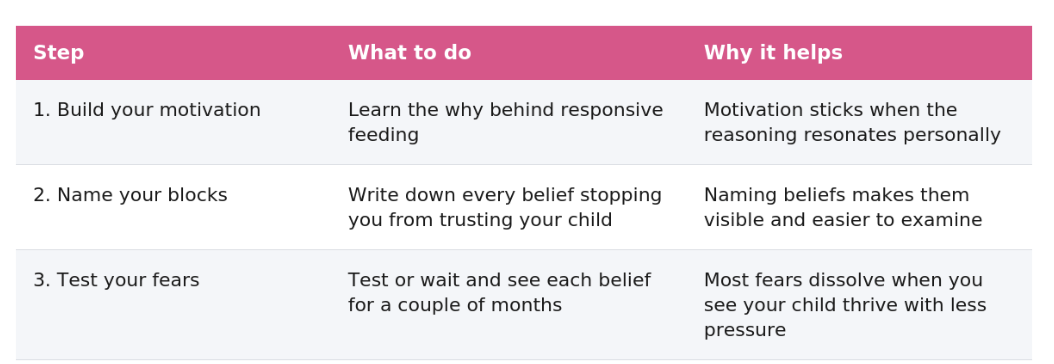
Easy Bites table showing three steps to trust your child and feed responsively without pressure.
Ready to Make the Shift?
If any of this resonates, you are already moving toward the gold standard feeding approach that paediatric experts recommend. The Easy Bites App is built to support exactly this kind of change, with daily expert tips on responsive feeding and personalised guidance tailored to your child. You do not have to figure this out alone.
Frequently Asked Questions❓
Is responsive feeding the same as permissive feeding?
No. Responsive feeding has clear structure: you decide what is served and when, and your child decides whether and how much to eat. Permissive feeding has no structure at all. The Division of Responsibility in Feeding, as defined by the Ellyn Satter Institute, is the key distinction.
How long does it take to shift to responsive feeding?
Most parents notice a change in mealtime atmosphere within 4 to 8 weeks. The mindset shift often takes longer because it means examining long-held beliefs. Be patient with yourself as much as with your child.
What if my child eats nothing if I stop encouraging them?
This is the most common fear, and it almost never plays out this way when the mealtime structure is solid. Your child decides how much to eat, but you control what is available and when. If you are genuinely concerned about growth, speak to your paediatrician. HealthyChildren.org has guidance on typical eating patterns across toddlerhood.
Is responsive feeding backed by research?🔬
Yes. Responsive feeding is the approach recommended by the American Academy of Pediatrics and is supported by decades of research on children’s eating behaviour.
How do I explain responsive feeding to my partner or family?
Share this article with them and point them to the Easy Bites App resources. The Ellyn Satter Institute also has clear, accessible explanations that work well for anyone who is sceptical.
Until next time,
Easy Bites
