
How to Help Picky Eaters Try New Foods: The 6 Rules That Protect Everything You Have Built (Part 4)
QUICK ANSWER
Helping picky eaters try new foods without undoing their relationship with food comes down to six rules: wait until you and your child are ready, wait until meals feel right, say nothing about the new food, use a light touch, follow your child's lead, and let go of the outcome completely. These rules only work if the mealtime groundwork from Parts 1 to 3 is already in place.
This is the final article in our four-part series. Before reading these rules, please check that the groundwork from Parts 1, 2, and 3 is in place. These rules will not work without it.
What Are the 6 Rules for Helping Picky Eaters Try New Foods Without Creating More Anxiety?
These rules exist to protect your child's relationship with food while creating space for genuine dietary expansion. Breaking any one of them, even with the best intentions, risks undoing the progress you have made.
Rule 1: Wait until you are ready
If you are genuinely worried about your child's weight, growth, or nutritional intake and you desperately want them to eat differently, pause before introducing any new foods. Children are extraordinarily sensitive to parental anxiety around food. Even when you believe your concern is invisible, your child will sense the weight of your expectations at the table.
This is not a judgment on you as a parent. It is a well-documented characteristic of the parent-child feeding relationship, sometimes called parental feeding anxiety. That anxiety, however understandable, risks making your child's eating more rigid, not less. If you are concerned about your child's growth or nutritional intake, speak to your GP or health visitor first. Once you have been reassured, the anxiety usually settles and you will find it far easier to follow these rules.
Rule 2: Wait until your child is ready
If your child becomes distressed simply by seeing new or unfamiliar foods near them at the table, this is a sign that their anxiety around food is still too high for opportunity creation to be useful. In clinical feeding terms, this level of sensitivity is called food-related anxietyand it is far more common than most parents realise.
The priority at this stage is not dietary expansion. It is rebuilding confidence and safety around mealtimes. Eat together as often as possible, keep your food and your child's food in the same space without comment, and let them get used to seeing what you eat with absolutely no expectation that they will try any of it.
Rule 3: Wait until meals feel right
If mealtimes are currently stressful, tense, or full of conflict, the priority is creating a calmer environment, not broadening your child's diet. The clinical term for what happens when children are overwhelmed at mealtimes is emotional dysregulation, which simply means their nervous system is too activated to safely explore or try anything new. A child in this state cannot benefit from opportunity creation.
Rule 4: Say nothing about the new food
Opportunity creation is the clinical term for what we are describing in this series: thoughtfully including foods your child has not encountered before, or foods that are just one small step away from something they already accept, with no further input from you.
Rule 5: Use a light touch with opportunity creation
Opportunity creation works best when it is casual, gentle, and repeated over time. The two tools it draws on are chaining away, offering a food one tiny step away from something already accepted, and next door neighbour foods, foods with similar sensory properties to accepted ones. Both are explained in detail in Part 3 of this series.
Rule 6: Let go of the outcome completely
This is the hardest rule, and it is the one that sits at the core of responsive feeding approaches to picky eating. The principle is straightforward: every time you serve a food as an intentional opportunity, check in honestly with yourself. Would you genuinely feel fine if your child ignored it, rejected it, or did not even look at it tonight?
What If I Do None of This? Will My Picky Eater Still Make Progress?
Yes. If you do none of the opportunity creation strategies in this series and simply eat together as a family, your child will still make progress.
The 6 Rules at a Glance
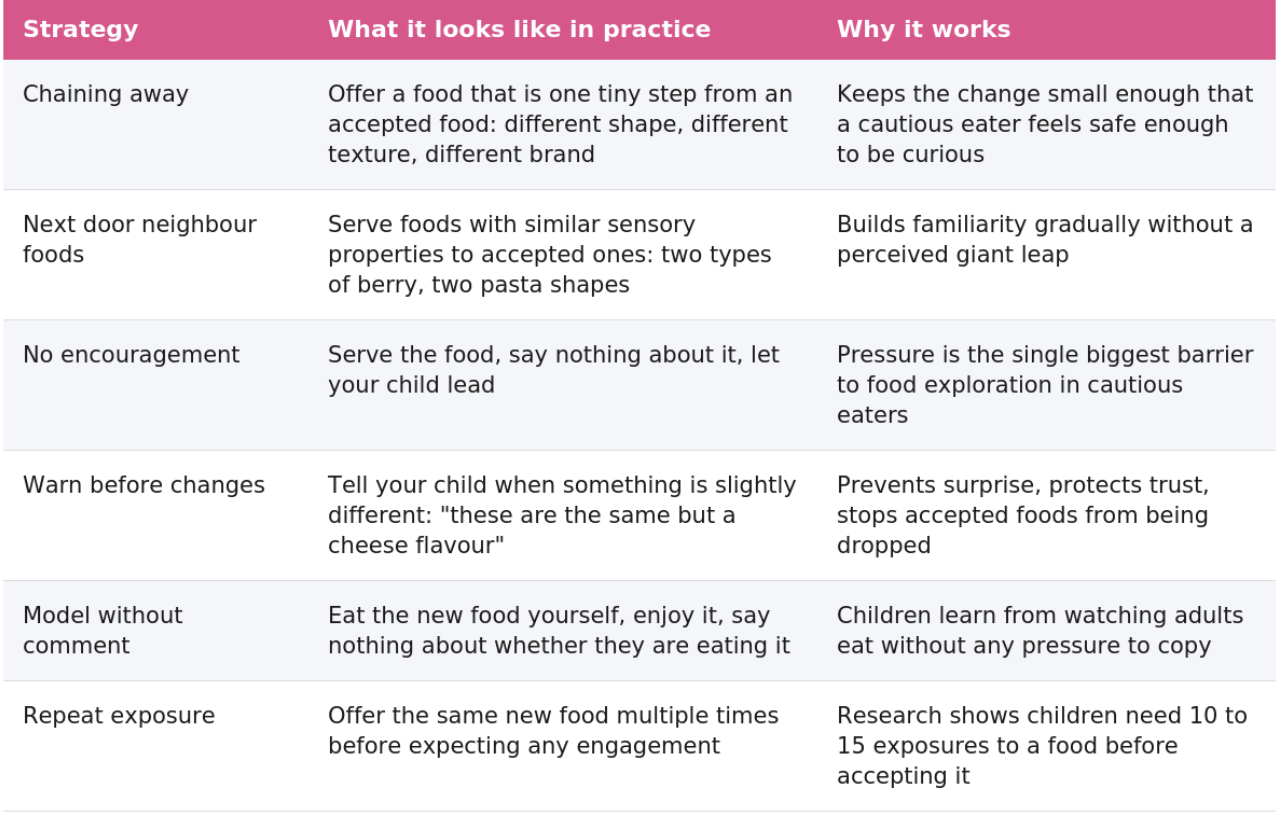
Table of strategies to help picky eaters try new foods: chaining, repeat exposure, modelling, and reducing pressure, with how each works.
Frequently Asked Questions
When is the right time to start creating opportunities for dietary expansion? 🧐
When mealtimes feel calm and connected, you are eating together regularly, your child has at least one safe food on the table at every meal, and you genuinely feel able to let go of the outcome. If any of those conditions are not yet in place, go back to Part 1 of this series and work on the foundations first.
What if I try opportunity creation and my child's eating gets worse? 🫐
This is a signal that either the mealtime groundwork is not yet solid enough, or that you had more of an agenda than you realised. Neither is a failure. Go back to basics: eat together, serve safe foods, remove all expectation, and give it more time. Opportunity creation requires a genuinely calm adult as much as a calm child.
Do I have to follow all six rules at once? 🤔
Yes, because they work as a system rather than as individual tips. The most common mistake is skipping Rule 6 (letting go of the outcome) while following the others. If you are still invested in whether your child tries something, the strategy will not work regardless of how carefully you are following the other five rules.
How long does it take before a picky eater tries something new? 👀
This varies enormously between children. Some explore a new food within a few exposures. Others take months or even years. The research on food neophobia consistently shows that repeated exposure without pressure is the most effective approach, but the timeline is entirely child-led. Measuring progress by whether your child tries something new is the wrong metric. Measure it by how calm mealtimes feel instead.
Is it possible to do too much opportunity creation? 🧑🧒🧒
Yes. If you are thinking about it intensely, planning meals around it, or noticing disappointment when your child ignores a new food, you have crossed from opportunity creation into agenda-driven feeding. The strategy works best when it is so light and casual that you barely notice you are doing it.
Until then,
Easy Bites
