
The Long-Term Benefits of Responsive Feeding 👧
Quick Answer
Responsive feeding supports four key long-term outcomes in children: greater enjoyment of food, the ability to self-regulate appetite, healthy weight maintenance, and willingness to eat a varied diet. Research consistently shows these benefits last into adulthood, making responsive feeding one of the most impactful things a parent can do at mealtimes.
If you have spent time with the Easy Bites App or have been reading our blog, you will know that the responsive feeding benefits we talk about are not just about making tomorrow's dinner go more smoothly. Small changes like eating together as a family as often as possible, using family-style serving, and focusing on connection can make a real difference, especially for picky eaters. But at its heart, responsive feeding is about the long game. The habits, feelings, and behaviours around food that children develop in their early years can stay with them for life.
Here are the four key areas where research shows responsive feeding makes a lasting difference, explained in plain language so you can see exactly what you are working toward when you invest in a positive mealtime environment.
Does Responsive Feeding Actually Make Mealtimes More Enjoyable?
Yes. Research shows that responsive feeding is associated with both reduced picky eating and increased mealtime enjoyment in children. Enjoyment is something we rarely talk about when we are anxious about whether our child is getting the right vitamins. But think about what it means for a child to grow up genuinely enjoying food. It shapes how they feel about mealtimes with friends, how they nourish themselves as teenagers, and how they relate to food as adults.
If you can prioritise both you and your child enjoying meals together, you are giving them something that goes well beyond nutrition. We are not talking about being entertaining or making every dinner a production. Just connected, positive time at the table, whatever that looks like in your family. That is the gift of raising a healthy eater.
Can Responsive Feeding Help My Child Know When They Are Full?
This is one of the most underappreciated responsive feeding benefits. Children's self-regulation eating refers to a person's capacity to eat when they are hungry and stop when they are full. To eat in response to genuine appetite.
This does not mean there are never other good reasons to eat. Accepting a slice of birthday cake even when you are not hungry is a perfectly healthy social behaviour. Eating a little more than you need because a dish is genuinely delicious is a joyful part of life. But day to day, a person who can effectively self-regulate their energy intake will be largely attuned to their body's signals and can respond accordingly.
Research confirms that responsive feeding helps establish children's self-regulatory capacity (Daniels, 2019), supporting them to eat in response to their body well into adulthood. This capacity, once developed in early childhood, is genuinely hard to undo. Getting it right early matters.
How Does Responsive Feeding Support Healthy Weight in Children? 🥦
We are all about weight inclusivity at Easy Bites. When we say responsive feeding and healthy weight go hand in hand, we mean maintaining a body weight that is stable and right for your child. Not pushing upward or downward from their natural growth curve. This is not about higher or lower weights being better or worse. It is simply that stable weight is a marker of functional eating.
The link between weight regulation and self-regulation makes sense when you think about it. Research shows that non-responsive feeding practices contribute to weight instability in children (Hurley et al., 2011), most likely because of their impact on a child's ability to read and respond to their own appetite signals. The CDC's guidance on healthy weight in children confirms that supportive mealtime environments are among the most effective protective factors.
Will My Child Eat a Wider Variety of Foods If I Use Responsive Feeding?🍎🥪🍚
Research shows that non-responsive feeding practices, like pressuring children to eat foods they do not want, can actually increase picky eating (Jansen et al., 2017). Pressure backfires. It narrows diet rather than broadening it, and creates negative associations with the very foods you are trying to encourage.
Responsive feeding works in the opposite direction. It supports a positive relationship with food where children can feel safe and confident exploring new foods in their own time. This is the foundation of a toddler varied diet that grows over time rather than staying stuck.
It is also worth saying that not every child is going to grow up to be a foodie, and that is completely fine. Even if your child never develops a passion for adventurous eating, responsive feeding can help them feel genuinely good about the foods they do eat, and expand their range as far as it naturally wants to go. The goal is not a restaurant critic. The goal is a person who has a comfortable, positive relationship with eating.
What Does Raising a Healthy Eater Really Mean? 🥑
When we talk about raising a healthy eater, we mean so much more than vitamins and portion sizes. It is about raising a child who feels comfortable in their body, feels positive about eating with other people, and can comfortably prepare their own food and stay nourished. It is about the child of today becoming the adult of tomorrow: someone who can find joy and connection in food, whatever their diet looks like.
None of this requires perfection. It requires intention. Start building the foundations today. Create your first family meal plan free on the Easy Bites App and let us help you put these principles into practice, one mealtime at a time.
The Long-Term Benefits of Responsive Feeding: At a Glance
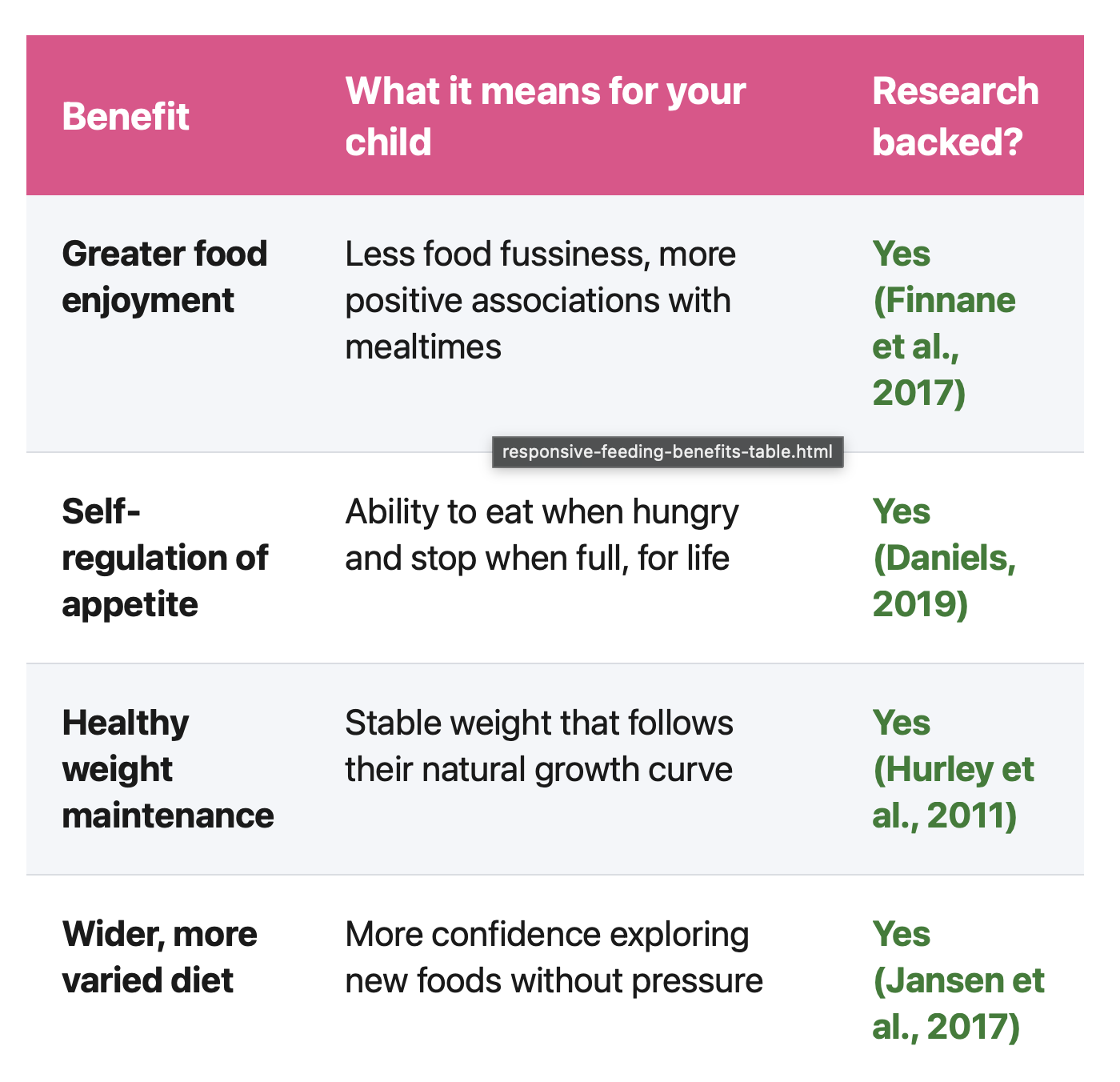
Summary chart of four long-term responsive feeding benefits: food enjoyment, appetite self-regulation, healthy weight, and varied diet
Frequently Asked Questions❓
What is responsive feeding? 🍼
Responsive feeding is an approach to mealtimes where parents provide the food and the environment, and children decide whether and how much to eat. It is the opposite of pressuring, bribing, or rewarding eating behaviour. The goal is to support children's natural hunger and fullness signals so they develop a healthy, self-regulated relationship with food. It is the foundation of raising a healthy eater for life.
Does responsive feeding really make a long-term difference? 👧
Yes. Multiple peer-reviewed studies show that responsive feeding is associated with long-term benefits including greater food enjoyment, better self-regulation of appetite, healthier weight trajectories, and a more varied diet. These are not short-term fixes. The eating habits, feelings, and behaviours around food that children develop in their early years genuinely shape who they become as adult eaters. The responsive feeding benefits are real and lasting.
Does responsive feeding help with healthy weight in children? 🥗
Research shows that non-responsive feeding practices, such as pressuring children to eat or restricting foods heavily, are linked to weight instability in children. Responsive feeding supports stable, healthy weight by helping children stay attuned to their own appetite signals rather than eating in response to external rules or emotions. The CDC's guidance on healthy weight in children highlights the importance of supportive, relaxed home eating environments.
How do I start using responsive feeding at home? 🤔
The most effective first steps are: eating together as a family as often as you can, serving meals family style so children can help themselves, removing pressure and praise around eating, and creating a relaxed, connected atmosphere at the table. The Easy Bites App guides you through all of this with a free family meal planner, practical tips, and a personalised Picky Eater Report.
Is responsive feeding backed by research? 🔬
Yes. The research base for responsive feeding is substantial. Peer-reviewed studies (Finnane et al., 2017; Daniels, 2019; Hurley et al., 2011; Jansen et al., 2017) consistently show its benefits across enjoyment, self-regulation, weight, and diet variety. These are published in respected nutrition and paediatrics journals and form the clinical foundation of Easy Bites' approach to child feeding.
Until next time,
Easy Bites
Finnane, J. M., Jansen, E., Mallan, K. M., & Daniels, L. A. (2017). Mealtime structure and responsive feeding practices are associated with less food fussiness and more food enjoyment in children. Journal of Nutrition Education and Behavior, 49(1), 11-18.
Daniels, L. A. (2019). Feeding practices and parenting: A pathway to child health and family happiness. Annals of Nutrition and Metabolism, 74(Suppl. 2), 29-42.
Hurley, K. M., Cross, M. B., & Hughes, S. (2011). A systematic review of responsive feeding and child obesity in high-income countries. Journal of Nutrition, 141(3), 495-501.
Jansen, P., de Barse, L. M., Jaddoe, V. W. V., Verhulst, F. C., Franco, O. H., & Tiemeier, H. (2017). Bidirectional associations between child fussy eating and parents' pressure to eat. Physiology and Behavior, 176, 101-106.
