
Quick Answer
Picky eating in toddlers is extremely common and is a normal part of child development - not a parenting failure. Research shows it affects up to a quarter of children and typically peaks around age 3 before improving by age 6. It is driven by biology, not by anything you have done wrong.
As parents, we put so much into doing our best for our little people - giving them the love and support they need to thrive, keeping them safe, and making sure they are healthy. Most of us have a pretty good idea of what constitutes a healthy diet, and providing our children with the right foods feels like part of our parental responsibility.
So when kids reject the foods we’d like them to be eating, this can feel like an abject parenting failure. Couple this with the statistic that just under a quarter of children may be picky eaters (although this figure varies across studies), and we’re left with a lot of parents feeling pretty rubbish about themselves. Alongside self-blame comes anxiety about how to help the child eat better, plus confusion about what to do about it.
Research suggests there may be a link between not understanding why picky eating in toddlers happens and parental self-blame. This makes sense: if we don’t know the reasons for a child’s food refusal, we’re left with “must be something I’ve done.” Especially when, as is often the case, an infant who gobbled up pretty much everything with relish has morphed into a toddler who will only countenance a narrow range of beige items.
We’re here to tell you this common feeling of self-blame is misplaced. It’s not your fault! Truly. Aside from situations involving abuse or neglect, nothing parents do causes picky eating. Sure, there are ways to respond that can make things better or worse but it isn’t something you have created. To understand typical child development around food, visit HealthyChildren.org — the American Academy of Pediatrics’ parent-facing resource.
Is Picky Eating Normal? What the Research Says 🤔
The first thing to know is that picky eating in toddlers is a natural part of typical child development. Many toddlers gravitate to a limited diet featuring very little greenery. Research suggests picky eating peaks at around age 3¹, usually having improved by age 6². This onset in toddlerhood happens for several reasons:
Toddlers are experimenting with their autonomy and practising the word “no” in many areas of life, this is a psychologically healthy part of typical child development
They are naturally neophobic - biologically wary of new foods, a trait known as food neophobia
They dislike bitterness more than in infancy³ - perhaps experiencing bitter flavours with more intensity during toddlerhood
They thrive on predictability - making processed foods feel “safer” than fruit, vegetables, meat, and fish, where each mouthful can taste different. This is a feature of toddler picky eating, not a failure of your cooking.
Why Do Toddlers Refuse New Foods? Understanding Food Neophobia
Some evolutionary psychologists believe food neophobia in toddlerhood may have supported the survival of our species, preventing children from wandering off and eating toxic leaves and berries once they became mobile. This is a compelling theory: toddler picky eating does seem to kick in around the same time children learn to walk. The CDC’s developmental milestones confirm this timing aligns with normal motor and cognitive development.
It also explains why toddlers are more sensitive to bitter flavours (associated with toxicity in nature) than they were as infants. So you see - they are literally programmed to be picky. Understanding this doesn’t make mealtimes easier overnight, but it does make the behaviour make sense. And when you understand why something is happening, it is much easier to respond to it calmly and without self-blame.
The Ellyn Satter Institute’s Division of Responsibility in Feeding offers one of the most evidence-based frameworks for creating a pressure-free mealtime, a key strategy for children with food neophobia.
When Does Picky Eating Become a Problem? Signs to Watch For
While picky eating in toddlers is usually a normal developmental phase, in some cases toddler food refusal goes beyond typical and reflects something that benefits from professional support.
Seek guidance from your healthcare professional if:
🍎 Your child doesn’t eat anything from one or more food groups (note: fruit and vegetables count as one group, so a child who eats fruit but no veg is NOT missing this group)
🥦 You are worried about their weight or growth
🫐 Their overall diet contains very few foods
👧 They reach school age and you are not seeing any improvement in variety you may want to get this checked out.
The American Academy of Pediatrics (AAP) notes that while most food rejection in toddlers is a normal part of typical child development, parents should watch for specific "red flags." According to their guide on Picky Eaters, if your child is meeting growth milestones and has plenty of energy for play, they are likely just moving through a standard phase. If you are concerned about weight loss or constant lethargy, consult your pediatrician. For a personalized look at your child's habits, try the Picky Eater Questionnaire in the Easy Bites App.
Is This Picky Eating Normal? A Quick Reference Guide
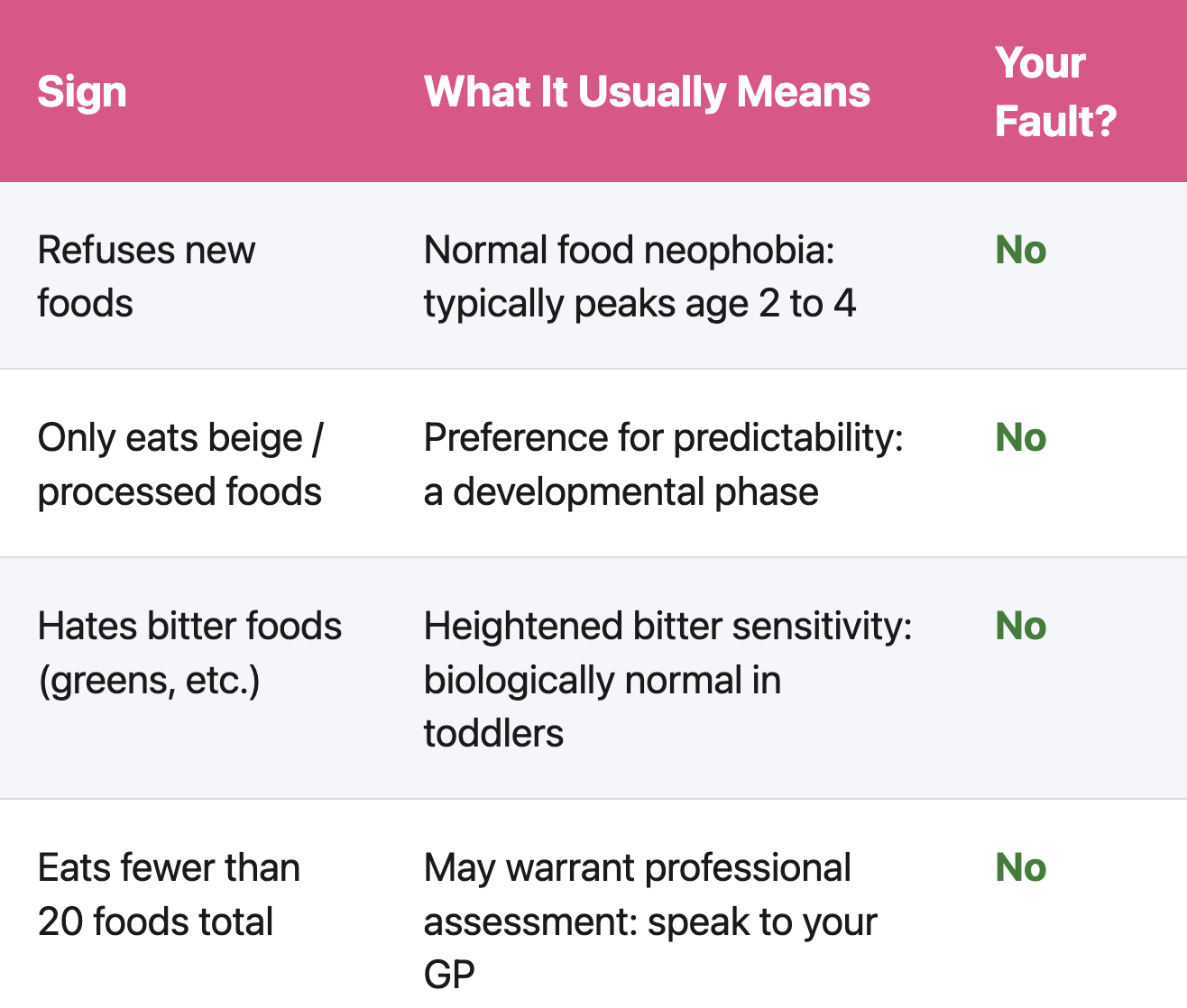
Table showing common picky eating signs in toddlers, what each sign means developmentally, and confirmation that none are the parent's fault.
If you’ve been blaming yourself for your child’s relationship with food - please don’t. You didn’t create it, and understanding why it happens is the first step to making things better. In Part 2 of this series, we explain the most common factors behind picky eating, as well as what is an expected developmental phase, so you can finally understand what’s really going on at your dinner table. And if you’re ready for personalised support right now, the Easy Bites App is built to help. Request your personalised Picky Eater Report to understand which factors may apply to your child and get practical, evidence-based guidance tailored to them. You’ve got this.
Frequently Asked Questions❓
Is picky eating in toddlers normal? 🍚
Yes, completely. Research shows that up to a quarter of children go through a picky eating phase, which typically peaks around age 3 and improves by age 6. It is a recognised part of typical child development, not a sign of bad parenting.
Why did my baby eat everything and now my toddler eats nothing? 🥗
This is one of the most common parenting experiences and one of the most confusing. Food neophobia (the biological wariness of new foods) kicks in during toddlerhood, around the same time children become mobile. It is thought to be an evolutionary protective mechanism. You didn’t do anything wrong; your toddler’s brain is doing exactly what it is programmed to do.
Is picky eating my fault? 🤷♀️
No. Research consistently shows that picky eating is driven by biological and developmental factors - not parenting choices. Aside from situations of abuse or neglect, nothing parents do causes picky eating. There are ways of responding that can help - which is exactly what the Easy Bites App is designed to support you with.
When does picky eating become a problem? 🤔
Speak to your paediatrician if your child eats fewer than 20 foods, is missing entire food groups, or if picky eating is not improving by school age.
Until next time,
Easy Bites
