
How Do I Get My Toddler to Try New Foods?Part 2: Building Curiosity-Led Food Exploration
Quick Answer
The most effective way to get a toddler to try new foods is to stop trying to make them. Children explore new foods naturally when mealtimes feel safe, relaxed, and pressure-free. Your job is not to push or reward. It is to create the right environment and trust your child to be curious in their own time. 🕰️
If you have not read Part 1 of this series, start there first. It explains what needs to be in place before you start thinking about getting kids to try new foods without pressure. We do not say this lightly: working on broadening your child's diet before the environment is right can actually make things worse. That includes how you feel and what you do at mealtimes.
When you have successfully laid those foundations, something shifts. The approach that actually works is rooted in what researchers call intrinsic motivation and food: the natural curiosity children have about eating when they feel safe. The Ellyn Satter Institute's Division of Responsibility in Feeding is the most evidence-based framework for this approach, and it underpins everything in this article. The core mindset shift is this: rather than directing or managing your child's new food trying, your role is to ensure that appropriate opportunities for exploration are there for when, and if, they are ready.
What Does Pressure-Free Food Exploration Actually Look Like?
Rather than directing or managing your child's new food trying, your role is to ensure that appropriate opportunities for exploration are there for when, and if, they are ready.
What to Say (and What Not to Say) at Mealtimes ❌ ✅
This is the most common place parents accidentally add pressure. Responsive feeding is not about what you say to encourage trying. It is about what you do not say. Here is the difference:
What creates pressure (avoid this):
"Jimmy, you might really like this new flavor of yogurt. Want to try a little taste?"
Pointing out a new food, naming it, and inviting a taste all put your child on the spot. Even positive encouragement can feel like pressure to a child who is not yet ready.
What creates safety (aim for this):
"Jimmy, there are two types of yogurt to choose from. The strawberry one we usually have, and a new peach flavor. They are in these bowls. Help yourself."
Even better, address the whole family and do not single out Jimmy at all:
"Today we have a new peach yogurt, plus grated cheese, crackers, some melon, cucumber, and ham slices. Help yourselves to whatever you fancy."
By creating the right environment, as we discussed in Part 1, you are nurturing your child's curiosity-led food exploration. When meals feel relaxed and your child has had a chance to build positive associations with being at the table, they are far less likely to experience the appetite-killing stress or anxiety that shuts down any interest in trying something new. When they feel genuinely free to make their own choices from the foods you provide, they will naturally start to explore foods beyond their usual repertoire.
How Curiosity-Led Food Exploration Works: Tommy's Story 👶
What this looks like in practice varies hugely for each child. Tommy¹ is seven and was a pretty picky eater as a toddler. Meals were consistently stressful, and his mum described him as strong-willed, always insisting on the same few foods on rotation. His parents went along with his requests because they were desperate for him to eat. When he turned five, things seemed to be getting worse, not better.
Tommy's parents sought professional help and worked with a responsive feeding specialist, who taught them how to help Tommy feel safe and relaxed at mealtimes. This is recognised by the American Academy of Pediatrics as an effective approach for children with significant toddler refusing new foods behaviours.
Over the next year or so, Tommy began asking questions about foods on the table, which were served family style."How does this taste?" "What is in that?" His parents knew not to leap in with suggestions that he try something. They were giving Tommy space to go at his own pace. Next, he began reaching out and sniffing or touching foods, or pulling a serving dish closer so he could take a better look. None of this was prompted by his parents, and they did not respond with praise or attention. They just stayed present and attuned, enjoying their food alongside Tommy.
One day, Tommy wordlessly started munching on a carrot stick. A completely new food. This was big. But his parents just smiled at one another and said nothing. "It's crunchy!" Tommy offered. "Sure is!" replied his mum. And the meal continued.
This is what children's food autonomy looks like in action. Nobody directed Tommy. Nobody praised him. Nobody even mentioned the carrot. The exploration was entirely his own, and that is precisely why it worked.
The Golden Rule: Stay Out of the Way 🥑
You can trust children to pace themselves perfectly when it comes to pressure-free food exploration. The skill is being really thoughtful about which foods you serve, so that opportunities for exploration are available when, and if, your child is ready for them. This has to be completely agenda-free. If a food is on the table because you are hoping or expecting your child to try it, you are back to pressure, and curiosity has gone out the window.
Read the final post in this series to learn about calibrating opportunities for dietary expansion. And if you want personalised support on how to get your toddler to try new foods without the pressure and anxiety, the Easy Bites App is built to guide you through exactly this process, step by step.
Pressure vs No Pressure: What Actually Helps Toddlers Try New Foods🍒🥪🥗
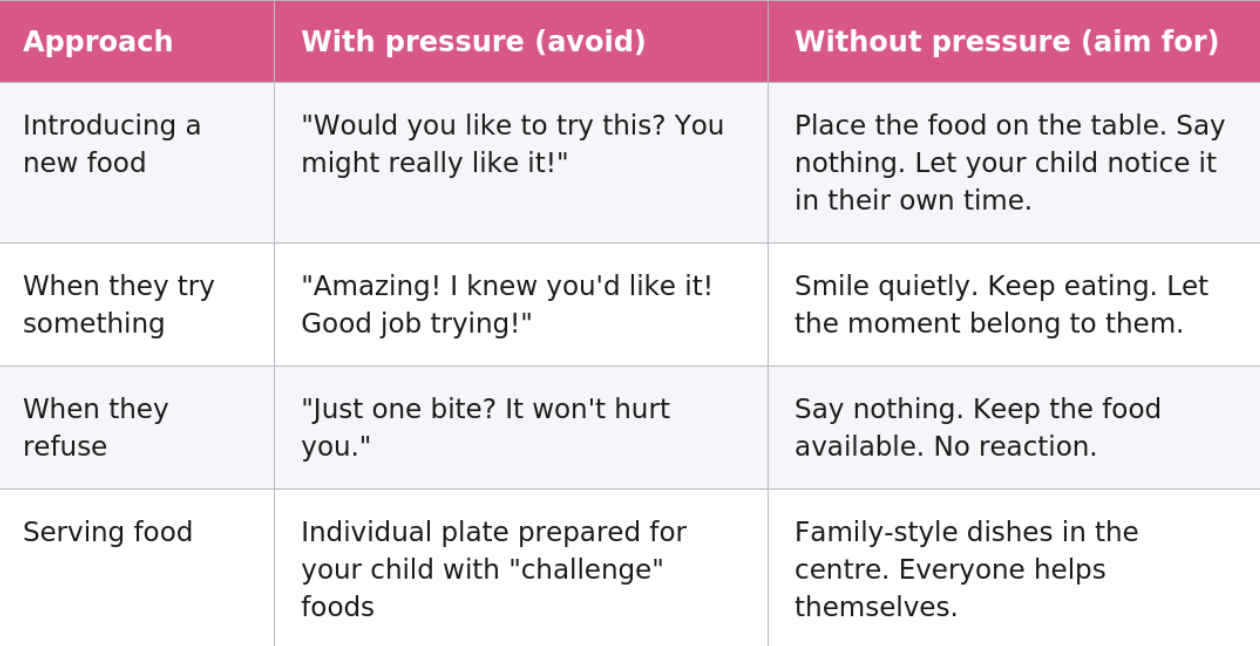
Comparison table of pressure vs pressure-free responses to help toddlers try new foods at mealtimes
Frequently Asked Questions❓
How do I get my toddler to try new foods? 🥣
The most effective approach is to stop trying to make it happen. Children are far more likely to explore new foods when mealtimes feel completely safe and relaxed. Offer new foods alongside familiar ones without comment, serve meals family style so your child can choose freely, and resist the urge to praise or pressure.
Should I reward my toddler for trying new foods? 🥦
No. Rewarding food trying, even with praise like "good job!" or "I knew you'd like it!", puts food in a performance context. It teaches your child that eating something is something they are doing for you, not for themselves. This undermines intrinsic motivation and food exploration. The goal is for your child to try things out of genuine curiosity, which only happens when there is no agenda attached.
Why does my toddler refuse new foods? ❌ 🍑
Food refusal in toddlers is usually a combination of normal developmental food neophobia (wariness of new foods), biological sensitivity, and mealtime anxiety. When a child senses any expectation around trying something new, anxiety spikes and curiosity shuts down. The solution is not more encouragement but a more relaxed mealtime environment. HealthyChildren.org has useful guidance on picky eating and when to seek professional support.
What is the division of responsibility in feeding? 🧠
The division of responsibility is a feeding framework developed by dietitian Ellyn Satter. It says: parents decide what food is offered and when. Children decide whether and how much to eat. Following this framework consistently is one of the most reliable ways to reduce mealtime stress and support children's food autonomy over time..
How long does it take for a toddler to accept a new food?
Research suggests children may need to be exposed to a new food between 10 and 20 times before they feel comfortable trying it. This exposure does not mean tasting: being at the table while a food is served, seeing it, smelling it, and touching it all count. Pressure-free food exploration makes this process faster, not slower, because curiosity is not being shut down by anxiety. The Easy Bites App can help you track food exposure and plan a varied weekly menu that supports this process.
Until then,
Easy Bites
¹Examples are amalgams of real cases, combined and worked with a responsive feeding coach who taught them how to help Tommy feel safe and relaxed during meals. Details have been changed to protect anonymity. The foods on the table (served family-style) were...
