
How to Help Picky Eaters Try New Foods: Creating the Right Opportunities (Part 3)
QUICK ANSWER
Helping picky eaters try new foods is not about encouragement or clever tricks. It is about creating pressure-free opportunities for curiosity to emerge on your child's terms. The two key strategies are chaining away, offering foods just one tiny step from something accepted, and next door neighbour foods, foods with similar sensory properties to ones your child already enjoys. Both work because they keep the change small enough to feel safe.
Important: If you are here for picky eating advice and you have not read Part 1 and Part 2 of this series, please read those first. The strategies in this article, taken out of context, can make picky eating worse. This article assumes the mealtime groundwork is already in place: no pressure, a calm environment, and your child's autonomy around food respected.
In Part 1, we explained why removing all pressure is the essential first step. In Part 2, we covered how children naturally build their relationship with food when the conditions are right. Now we are ready for Part 3: creating the right opportunities for picky eater diet expansion to happen at your child's pace.
Why Does Standard Food Chaining Often Fail Picky Eaters?🤷♀️
Food chaining is a recognised clinical strategy for expanding a child's diet, but the way it is typically used often backfires with truly cautious eaters.
You may have come across food chaining, a clinical approach where adults choose a target food and create a chain of small steps from an accepted food toward it. For example, a chain toward carrots might go: potato chip, sweet potato chip, roast carrot, boiled carrot.
The problem is that what looks like a baby step to an adult can feel like a giant leap to a food-anxious child. The sensory difference between a potato chip and a sweet potato chip involves a change in colour, taste, texture, and smell all at once. For a child with heightened sensory sensitivity, which is one of the most common causes of picky eating, that is not a small step at all. Research on food neophobia, the biological wariness of new foods, consistently shows that pushing too far too fast increases anxiety rather than reducing it. The Ellyn Satter Institute emphasises that children need to feel in control of the process for any food learning to happen.
What Is Chaining Away and How Does It Help Picky Eaters?
Chaining away is a gentler version of food chaining that starts from where your child actually is, not where you want them to end up.
Instead of selecting a target food and working toward it,you simply offer something that is just one very small step away from a food your child already accepts. The change might be:
Toast cut into triangles when it is usually squares 🥪
Cheesy mashed potato instead of plain mashed potato 🧀
A different pasta shape 🍝
A ridged crisp instead of a flat one 🍎
A slightly different brand of the same biscuit 🍪
None of these feel significant to us as adults. But to a cautious eater they are real, manageable experiments. The change is visible, predictable, and does not carry any parental expectation attached to it. That last part is crucial: chaining away only works when there is zero pressure to try the new item.
What Are Next Door Neighbour Foods and Why Do They Work?
Next door neighbour foods are items that share sensory properties with an accepted food without being the same thing. Think of them as the bridge between what your child eats now and what they might eat in the future.
The idea is to make new foods feel familiar before your child has even tasted them. If your child eats strawberries, raspberries are a next door neighbour food: similar colour, similar texture, similar smell, similar sweetness profile. If your child eats plain pasta, orzo is a next door neighbour food. If your child eats chicken breast, turkey breast is a next door neighbour food.
By regularly including next door neighbour foods on the table alongside accepted foods, and by never commenting on them or encouraging your child to try them, you are creating repeated low-pressure exposure. Research shows that children typically need somewhere between 10 and 15 exposures to a food before they accept it. Most parents give up after two or three. HealthyChildren.org (AAP) supports repeated neutral exposure as one of the most evidence-based approaches to dietary expansion.
What Does This Look Like in Practice? A Real Example
Here is how one parent used chaining away and next door neighbour foods to create genuine dietary expansion for his son, without a single moment of pressure.
Carlos eats a lot of starchy foods and enjoys fruit, especially melon and berries. He likes fish fingers, sausages, and chicken breast. His dad Miguel would love for Carlos to eat some vegetables. The only vegetable-adjacent food in Carlos' diet is cucumber.
Having read about responsive feeding, Miguel knows that encouraging Carlos to try vegetables makes things worse and undermines the calm mealtime environment he has worked hard to build. He has also checked with their GP and confirmed Carlos is growing well and meeting his nutritional needs without vegetables, thanks to fruit and a multivitamin. So Miguel starts with chaining away from potato chips, a food Carlos already accepts.
Week 1: Introducing the ridged crisp 🥪
Miguel buys ridged plain crisps and a cheese-flavoured crisp in the same shape as Carlos' usual ones. On Monday, he puts out a bowl of ridged crisps alongside fish fingers, mashed potato, cucumber and broccoli
Carlos notices immediately. "These look weird!"
"Yep, they're kind of stripy," Miguel replies.
No encouragement to try. No focus on the new item. Just a calm, warm response that validates Carlos' observation.
Carlos eats fish fingers, cucumber and a little mash. Miguel eats the same meal and has a couple of the ridged crisps himself, without comment.
Week 2: The second exposure 🥑
On Thursday, Miguel serves the ridged crisps again. This time Carlos reaches for a few and puts them on his plate. He eats nothing from the plate and leaves them all.
Miguel says nothing. He does not ask whether Carlos is going to try one. This restraint is one of the hardest things parents face in this process and one of the most important.
Week 3: The breakthrough 🥦
The following week Miguel serves ridged crisps again, alongside sausages, carrots and chips, one of Carlos' favourite dinners. This time Carlos takes a couple, has a tentative lick, decides they are a winner, and eats them with enthusiasm, going back for seconds.
This is how picky eater diet expansion actually works. It is slow, non-linear, and completely led by the child.
The warning rule: never surprise your child 👧
When Miguel eventually introduces the cheese-flavoured crisp, he will tell Carlos in advance: "these are like the plain ones we usually have but they taste of cheese." This is a critical part of the process.
Never give a child an unexpected food experience without warning them first. Even a small surprise can feel like a betrayal of trust to a food-anxious child, and can cause previously accepted foods to be dropped entirely. Always flag a change before it arrives on the table.
Why Does It Matter If My Child Just Tries a New Type of Crisp?
The nutritional value of the new food is almost irrelevant at this stage. What matters is the experience your child has had.
Carlos has experienced feeling curious about a new food and having the space to explore it entirely at his own pace. He has learned that new foods can be interesting rather than threatening. He has had that experience inside a calm, trusting mealtime relationship with his dad.
This is the foundation that makes genuine dietary expansion possible. Had Miguel gone straight to vegetables, Carlos' eating would very likely have regressed and mealtimes would have become more stressful for everyone.
Children who have repeated positive experiences of this kind: curiosity met with space, novelty met with calm, new tastes explored without pressure, are paving their own way toward a wider diet. Some children take much longer than Carlos. Every child is different. But the mechanism is the same.
How Do I Know If I Am Doing This With the Right Attitude?
This is the most important question in this entire series. The strategy only works when the goal in your head is making appropriate foods available, not getting your child to eat differently.
As you have probably gathered from reading this, creating opportunities for dietary expansion is a delicate business. The moment your agenda shifts from "I am making interesting foods available" to "I want them to eat this", the pressure returns and the opportunity disappears.
A few questions to check yourself with:
Am I serving this food because it fits naturally into our meal, or because I want them to try it?
Would I be genuinely fine if they did not engage with it at all tonight?
Am I enjoying the meal myself, or am I watching to see what they do?
Am I planning to say anything if they try it or if they do not?
If the answers make you realise your agenda is still about outcomes rather than process, that is completely normal. It takes time.
Part 4 of this series sets out some simple rules to keep you on track as you create opportunities for dietary expansion. Read Part 4 here.
Strategies for Helping Picky Eaters Try New Foods: At a Glance
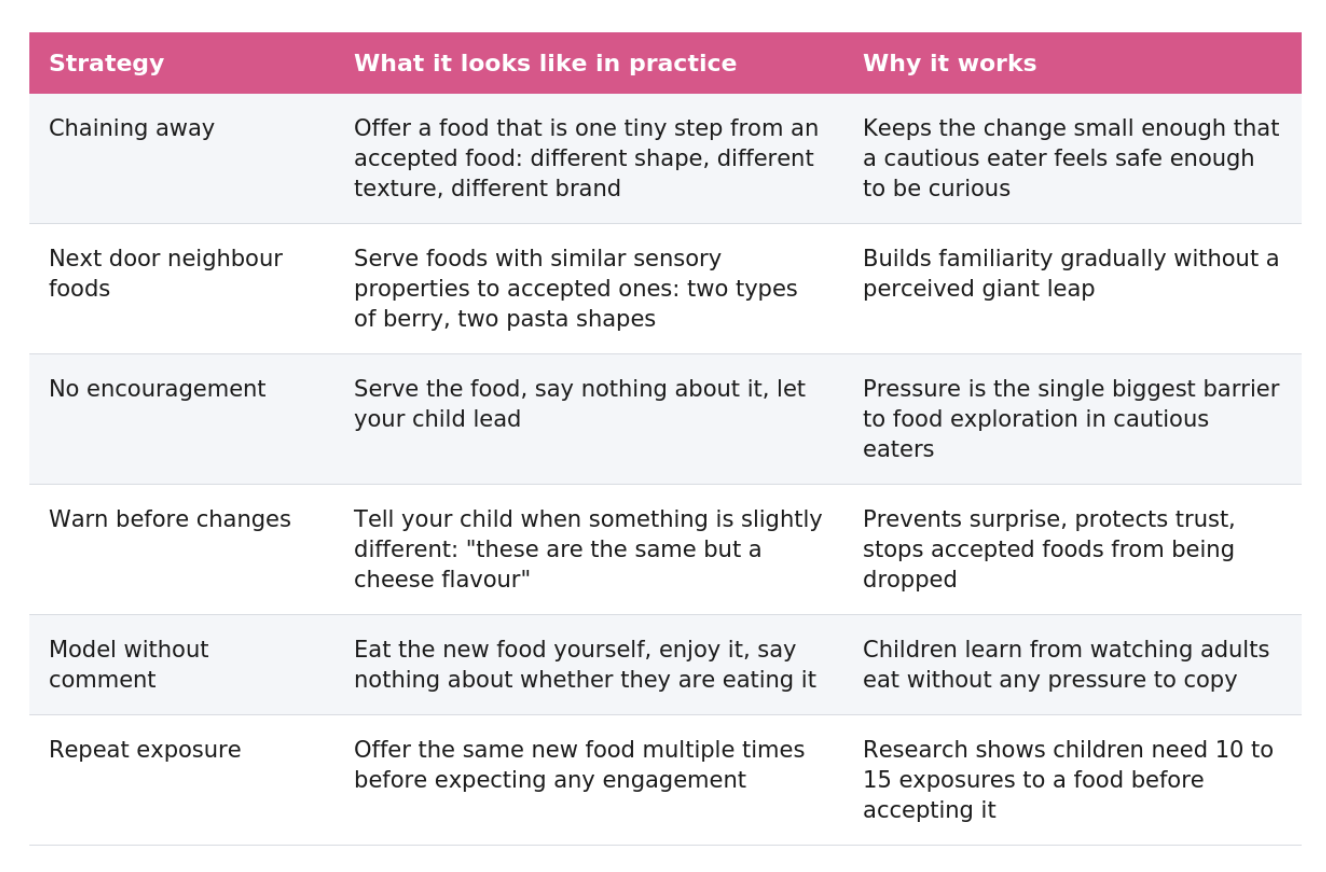
Easy Bites table showing gentle strategies to help cautious eaters try new foods without pressure.
Ready to Support Your Child's Dietary Expansion? 🍓
The Easy Bites App is built to help you navigate exactly this process. Request your personalised Picky Eater Report to understand what is driving your child's eating and get practical, evidence-based guidance tailored to their specific needs. You do not have to figure this out alone.
Frequently Asked Questions❓
What is food chaining for picky eaters?
Food chaining is a clinical approach where you create a sequence of small steps from an accepted food toward a new one, changing one element at a time. For example, moving from a plain crisp to a ridged crisp before eventually working toward a vegetable. Chaining away is a gentler version that starts from where your child is rather than working toward a specific target food.
How many times does a child need to be exposed to a food before they try it? 🤔
Research suggests children typically need between 10 and 15 exposures to a food before they accept it. Most parents give up after 2 or 3 because it feels like it is not working. The key is that these exposures must be completely pressure-free. Offering a food while hoping or watching for a reaction counts as pressure and resets the process.
Should I tell my child when a food is slightly different? 🍑
Yes, always. Never give a food-anxious child a surprise. If something has changed, tell them before they encounter it: "these are the same crisps but a different flavour." This protects trust, reduces anxiety, and prevents the surprise from causing previously accepted foods to be dropped. The warning does not need to be a big deal; a calm, factual mention is enough.
What if my child does not try anything new for months? 👶
This is normal. Picky eater diet expansion is slow and non-linear. Some children take much longer than others. What matters during this period is that mealtimes remain calm and positive, your child continues to feel safe and trusted around food, and next door neighbour foods and chaining-away options continue to appear regularly on the table without comment. The groundwork you are laying now is what makes expansion possible later.
Is this approach only for very picky eaters?
No. The principles of chaining away and next door neighbour foods, combined with pressure-free mealtimes, apply to any child who is cautious around food. Even children who are only mildly selective can benefit from this approach, particularly during developmental phases where they become temporarily more wary of new foods.
Until then,
Easy Bites
