
Why Is My Toddler a Picky Eater? 4 Common Causes
Quick Answer
Toddler picky eating is most commonly caused by one or more of four biological factors: sensory sensitivities, neurodiversity, emotional temperament, or genetic taste perception. These are hardwired traits, not the result of parenting. According to our in-house child feeding specialist, Dr. Jo Cormack, understanding these "why" factors is the first step to helping an anxious eater.
The most common biological causes of food rejection in toddlers are:
Sensory differences- heightened sensitivity to textures, smells, and tastes. 🥪
Neurodiversity- children on the autism spectrum are significantly more likely to have a narrow diet. 🧠
Temperament- children who regulate emotions with difficulty tend to be pickier eaters. 👶
Genetic taste perception- some children are “supertasters" who experience flavors more intensely. 🫐
Understanding why your toddler is a picky eater starts with looking at how they experience the world, not with questioning your parenting. Let’s explore each cause in detail.
Why Does My Child Hate Certain Textures, Smells, or Foods? (Sensory Differences) 🤔
We all experience the world differently, and children with sensory processing differences often find eating extra hard. They may look for strong sensory signals like crunchiness, or may be extremely sensitive to smell, for example. You might already have a sense that your child is showing signs of sensory sensitivity (do they hate the sound of hand dryers in public restrooms, or demand that all labels be removed from their clothes?), but sensory differences can also manifest in less obvious ways. Fill out our Picky Eater Questionnaire to get a sense of whether your child may have some sensory differences.
Sensory differences can also show up in less obvious ways. The Ellyn Satter Institute’s Division of Responsibility in Feeding explains how creating a low-pressure, predictable mealtime environment is one of the most effective ways to support a sensory-sensitive child.
Could My Child’s Picky Eating Be Linked to Autism? (Neurodiversity and Food) 🧠
Being on the autism spectrum makes children much more likely to gravitate toward a narrow, repetitive diet¹. If your child is a picky eater, that doesn’t mean they’re autistic and if they are autistic, that doesn’t mean they will necessarily be a picky eater. But neurodiversity could very well explain their eating difficulties.
There are several reasons why autism and picky eating in toddlers often go hand in hand - from heightened sensory sensitivities to a strong need for routine. For a clinical overview, HealthyChildren.org (American Academy of Pediatrics) has a helpful guide on health issues and autism.
If your child is autistic, their food rejection may look different from a typical picky phase, and acceptance of who they are is key. While you need to be sure your child is meeting their energy and nutrition needs, if they are autistic, acceptance of who they are is key. This could mean coming to terms with them eating a diet that falls short of how you’d like them to be eating.
Why Does My Child Have Such Strong Reactions at Mealtimes? (Toddler Temperament)
Certain aspects of a child’s toddler temperament, including how they regulate their emotions are strongly associated with picky eating². If your child gets upset more quickly or more intensely than other children their age, they are more likely to be a picky eater. This is one of the least talked-about causes of food rejection in toddlers and one of the most exhausting to live with.
As a parent, you’re not only managing mealtime battles, you’re also managing a genuinely distressed small person, often at the end of a long day. That is hard. And it is not a reflection of your parenting. We go into these temperamental factors in depth in your Picky Eater Report.
Why Does My Child Hate Greens So Much? (Supertasters and Genetic Taste Perception) 🥬
We are all different when it comes to how powerful our sense of taste and smell is. But some people are what are known as “supertasters” - they genuinely do experience flavours more intensely than most. This has a strong genetic taste perception component, meaning it is simply part of how your child was made.
If your child’s personal nightmare is a plate of nutritious greens, that may just be how their biology works. And again - not your fault. The Ellyn Satter Institute’s Division of Responsibility in Feeding offers one of the most evidence-based frameworks for creating a pressure-free mealtime where your child can thrive.
It’s Not Your Fault: Accepting Your Child’s Relationship With Food
We’ve said it before and we’ll say it again. Although this article hasn’t covered every possible cause of picky eating in toddlers, we hope it’s gone some way toward explaining that you are not to blame. Maybe it’s a natural, developmental phase. Maybe it’s just part of who your child is. But it isn’t you ‘missing a crucial window’ when they were a baby, or ‘being too soft’, or ‘giving too many snacks’.
You didn’t create your child’s relationship with food and accepting them for who they are is key. The Easy Bites App is built to help you navigate exactly this - with evidence-based guidance, a personalised Picky Eater Report, and a community of parents navigating the same thing. You’ve got this, and we’re right here with you.
Signs and Typical Behaviours for Each Cause of Toddler Picky Eating
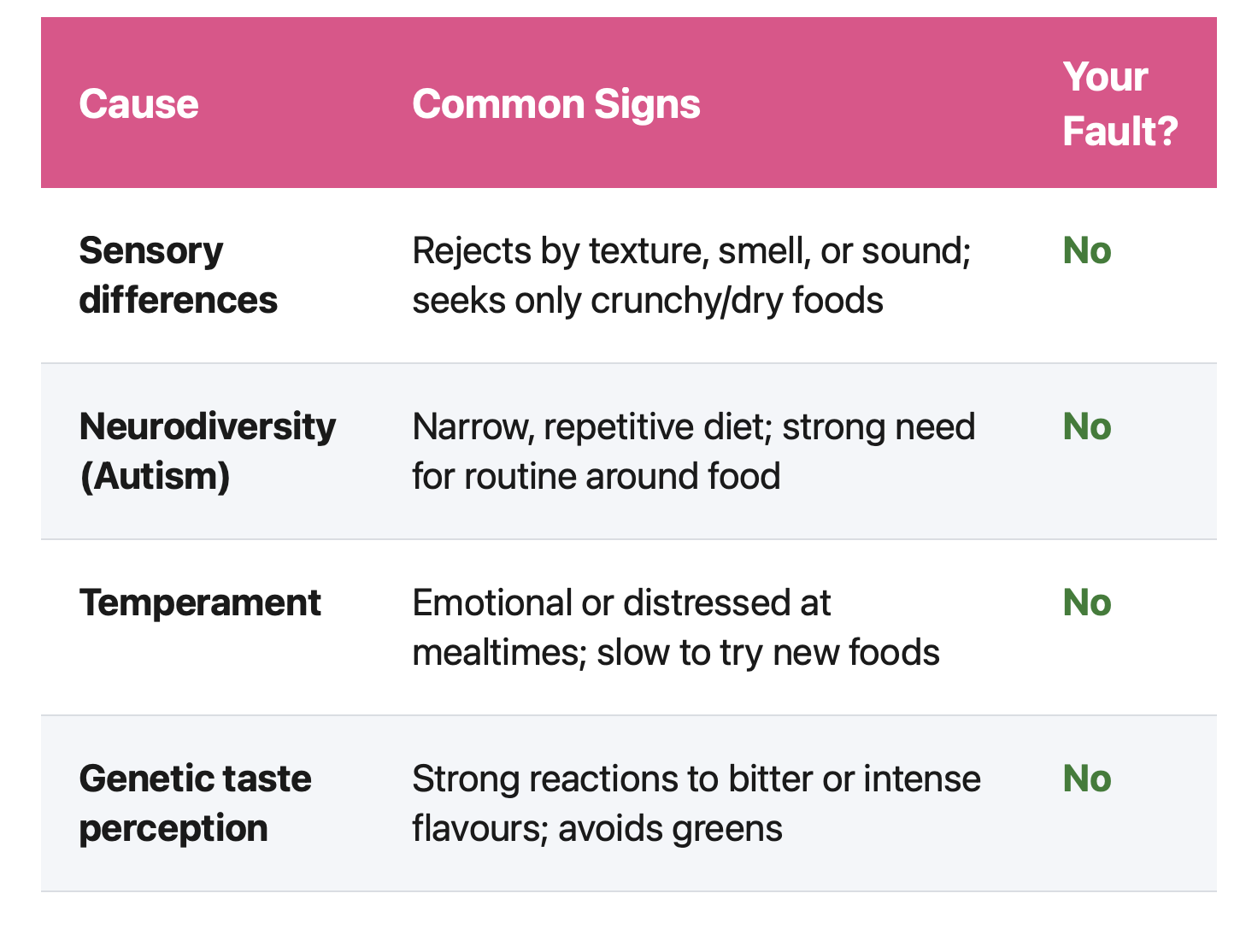
Table of signs and typical behaviours for four causes of toddler picky eating: sensory differences, neurodiversity, temperament, and taste perception
Frequently Asked Questions❓
Is picky eating typical in toddlers? 👶
Yes. Most toddler picky eating is a completely normal part of typical child development. Between ages 2–5, food refusal and reluctance to try new foods are expected behaviours. However, if your child is losing weight, eating fewer than 20 foods, or showing significant distress at every mealtime, speak to your pediatrician.
What are the most common causes of picky eating in toddlers? 👀
The four most common biological causes are sensory sensitivities, neurodiversity (including autism), emotional temperament, and genetic differences in taste perception (supertasters). None of these are caused by parenting choices; they are biological traits your child was born with.
How do I know if my child’s picky eating is a problem? 🤷♀️
It is helpful to look at how their eating affects their daily life rather than just the variety of food on their plate. A typical picky phase usually involves a child who still eats enough calories to grow and remains generally energetic. It might be a broader issue if your child consistently avoids entire food groups (like all proteins or all vegetables), loses weight, or if mealtimes have become a source of significant distress and "battles" for your entire family. If you notice your child is falling behind on growth milestones or seems to have lower energy more often, it is always best to consult your pediatrician.
Can picky eating be genetic? 🍓
Yes. Research shows that taste perception has a strong genetic component. Some children are “supertasters” who experience bitter and intense flavors much more powerfully than the average person. This is a biological difference, not a preference or a behavior that can be trained away.
Will my picky eater grow out of it? 🍑
Many children naturally expand their diet over time, especially in a low-pressure, supportive mealtime environment.
Until then,
Easy Bites
¹ Baraskewich, J., von Ranson, K. M., McCrimmon, A., & McMorris, C. A. (2021). Feeding and eating problems in children and adolescents with autism: A scoping review. Autism, 25(6), 1505–1519.
² Haycraft, E., Farrow, C., Meyer, C., Powell, F., & Blissett, J. (2011). Relationships between temperament and eating behaviours in young children. Appetite, 56(3), 689–692.
³ Cena, H., & Oggioni, C. (2016). Tasters, supertasters, genes and environment. In Human Nutrition from the Gastroenterologist’s Perspective (pp. 123–138). Springer.
Cormack, J. (2019). Hear the Fear: A Language Tool for Parents of Anxious Eaters. Jo Cormack — Child Feeding Specialist. Retrieved from https://www.jocormack.com/2019/03/05/hear-the-fear-a-language-tool-for-parents-of-anxious-eaters/
